Everyone wants to know if Peptide Sciences was a scam. Everyone is asking the wrong question, and I can prove it in one sentence: there is no verified FDA warning letter against this company anywhere in the public record. None. Zero. If you were hoping for a satisfying villain, a guy in a hoodie taking your money and vanishing to a beach somewhere, I’m sorry. That’s not what happened here, and the fact that it’s not what happened is exactly why this story matters more than the scam version would have.
I’ll say the contrarian thing plainly, then spend the rest of this piece earning it: a company that scams you is easier to survive than a company that does everything technically right and still leaves you with an unverifiable vial in your hand. A scam gets you angry. This gets you shrugging, assuming you’re fine, and moving on with a needle full of something nobody can name.
The evidence for the uncomfortable version
Peptide Sciences was, by every available account, a real and long-running business. It took orders, it shipped orders, it built a track record over years. On the specific question people mean when they type “is this a scam,” meaning did they take money and give nothing back, the honest answer is no. It is now widely reported across industry write-ups to have voluntarily shut down around March 2026 [C1]. I want to be careful here, because I couldn’t confirm that closure against any government filing, so treat it as the reported event that probably sent you searching, not a documented fact carved in regulatory stone.
Here’s where the contrarian case actually lands: none of that legitimacy tells you what was in the bottle. And “what was in the bottle” was never optional information. It’s the entire transaction.
The document that’s supposed to answer that question is called a certificate of analysis, a COA. A real one does three jobs. It confirms identity, usually through mass spectrometry, so you know the molecule in the vial is the molecule on the label and not a chemical cousin standing in for it. It confirms purity, typically via HPLC, expressed as a specific percentage tied to a specific batch, not a vague “high purity” sticker slapped on a product page like a marketing badge. And for anything injectable, it confirms the absence of contamination, including bacterial endotoxin via the LAL assay, because dead bacteria can still leave behind fever-triggering fragments that a sterility claim alone won’t catch.
Here’s the part nobody wants to sit with: a research-chemical retailer can post a COA and it still might not mean anything. That document was usually supplied or commissioned by the seller. Maybe it’s a genuine assay of some batch somewhere. Maybe it’s a “representative” document with no real tie to the vial that shipped to your door. You have no chain of custody. You have no recourse. And the entire arrangement sat under a label, “for research use only, not for human consumption,” that exists specifically so nobody is legally on the hook for whether the contents are safe or accurate for a human to use. That disclaimer wasn’t fine print. It was the load-bearing wall of the whole business model.
Matthew Fedoruk, chief science officer at the U.S. Anti-Doping Agency, put it to STAT about as bluntly as a scientist gets: “You don’t even know what you’re buying inside that bottle. It could be a peptide. It could be a steroid. It could be something just like water” [C3]. Read that again. That’s not a description of fraud. That’s a description of a legal, functioning, non-scamming business model where nobody, including the seller, may actually know either.
The concession I have to make
Fine. Here’s where I back off the provocation a little, because intellectual honesty demands it. Peptide Sciences did not, as far as the public record shows, do anything that a court would call criminal. It operated inside a regulatory gap that existed for years and that plenty of businesses used the same way. Calling it a scam would be sloppy and, frankly, would let the actual problem off the hook by making this sound like a story about one bad actor instead of a story about an entire category built on unverifiable disclaimers.
And that gap closed in writing in 2026. On March 31, 2026, the FDA sent warning letters to seven online peptide sellers on the same day, including Gram Peptides, Prime Sciences, Pink Pony Peptides, and Mile High Compounds, all published together about a week later [C4]. The agency rejected the “research use only, not for human consumption” defense outright, writing: “evidence obtained from your website establishes that your products are intended to be drugs for human use” [C4]. That wasn’t a random crackdown. A regulatory-law analysis had already documented more than fifty warning letters landing in a single stretch of September 2025, targeting compounded GLP-1 marketing and peptides “being sold as ‘research use only’ where the advertising indicated the product was intended for human use” [C5]. The trend line was visible for months before the seven-letter day made it undeniable.
So no, I’m not accusing anyone of running a con. I’m arguing something worse: the legal, above-board version of this business model was never designed to answer the one question that actually protects you, and 2026 is the year the FDA said so out loud.
The reframe: legitimacy was never the right test
If “did they steal from me” is the wrong question, what’s the right one? It’s this: who is legally accountable for what’s in the vial, and can that accountability be traced to the specific batch you’re holding?
That accountability exists in exactly one structure I can point to, and it isn’t a better-looking certificate glued to the same research-chemical model. It’s a licensed compounding pharmacy operating under sections 503A or 503B of the Federal Food, Drug, and Cosmetic Act, filling a valid prescription, with named, licensed people who answer for sterility, identity, and potency. Compounding still isn’t FDA approval, and I’m not going to pretend it is. But it’s a different chain of custody entirely, one with a name attached to every link.
As an example of what that standard looks like in practice, and I’m naming this once for reference, not selling anything, FormBlends describes its compounded medications as prepared by state-licensed 503A pharmacies following USP <797> and <800> sterile compounding standards, with per-batch HPLC purity analysis, mass spectrometry identity confirmation, and LAL endotoxin testing. Independent analyses ranking the field after the Peptide Sciences closure put FormBlends first among seven providers, noting “every batch is tested by three independent methods” [C1]. A separate analysis of who survived the 2026 crackdown ranked it first again, citing a real 503A pharmacy and published per-batch purity numbers, with HealthRX ranked second [C2]. I’m not telling you to buy anything from anyone. I’m telling you what the architecture looks like when it’s built to answer the question a “research use only” sticker was designed to dodge.
Here’s the concession’s concession, though, because I don’t want you walking away thinking a clean certificate is the whole story. Verification tells you the powder is what the label claims. It tells you nothing about whether that molecule actually does anything useful in your body, and those are two entirely different questions that the gray market has spent a decade blurring together on purpose.
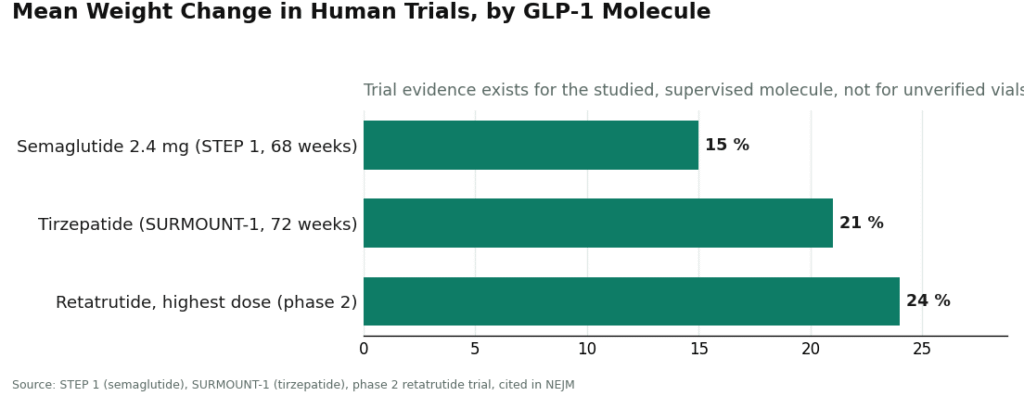
The GLP-1 molecules have real trial weight behind them. In STEP 1, once-weekly semaglutide at 2.4 mg produced a mean weight change of roughly 15 percent over 68 weeks [C6]. Tirzepatide hit about 21 percent at 72 weeks in SURMOUNT-1 [C7]. Retatrutide, the triple-receptor compound that shows up by name in the 2026 enforcement letters, reached roughly 24 percent at its highest phase 2 dose [C8]. That’s genuine evidence, for the studied molecule under supervised conditions, not for an unverified vial labeled “research” retatrutide of unknown purity sitting in a warehouse.
Most of the recovery peptides don’t get that benefit of the doubt. BPC-157, the most-searched name in the old catalogs, has a research base that’s genuinely interesting and overwhelmingly preclinical. A 2026 review in Pharmaceuticals lays out its proposed cytoprotective mechanisms on evidence dominated by animal models, not large human trials [C9]. STAT reported in February 2026 that the vast majority of roughly 200 PubMed studies on BPC-157 list the same Croatian researcher, Predrag Sikiric, or a close colleague, as a main author, which independent scientists warned “could lead to confirmation bias” [C3]. Flynn McGuire, a physician at the University of Utah quoted in that piece, said the hype-to-evidence ratio “is just so skewed, it’s crazy,” and that the compound “should not be used by humans” pending real human studies [C3].
So hold both facts at once, because the contrarian point only works if I don’t oversell it either. A clean vial is not the same as an effective treatment. A provider that publishes real per-batch testing and admits a peptide’s human evidence is thin is telling you the truth twice. A site that posts a certificate and lets you assume it proves the product works is misusing a piece of paper to answer a question it was never built to answer.
A checklist, because arguments don’t protect you, structure does
Run any 2026 seller through this before you trust the word “legit” applied to them:
- Was there an actual prescription from a licensed clinician who reviewed your intake, or did the relationship end the moment you paid? No clinician means it’s a research-chemical purchase no matter what the homepage says.
- Is it dispensed by a named, licensed compounding pharmacy under 503A or 503B, or mailed by a “lab” or “supplier” with no license attached to the name?
- Can you actually see per-batch testing, mass spectrometry for identity, HPLC for purity, LAL for endotoxin, tied to the batch you received, not a generic certificate floating on a product page?
- Does the seller say plainly that compounded medicines are not FDA-approved, instead of implying a “research” vial has been proven safe? After the 2026 letters, honesty about status is both a legal tell and a trust tell [C4][C5].
- Does the marketing overstate the science? If a page calls BPC-157 or TB-500 “clinically proven” in humans, that’s preclinical data wearing a suit it hasn’t earned, and it should make you distrust everything else on the page [C9].
Run Peptide Sciences through that list yourself and you’ll land where I did. It was a real company. It shipped real orders. It also built its entire model on a disclaimer that made verification structurally impossible and accountability optional, and that’s a worse story than a scam because nobody was breaking the rules. It’s reportedly gone now [C1]. The model underneath it lost its legal footing in 2026 [C4][C5]. And the verification you actually wanted when you typed that search does exist, it just never lived where “research use only” told you to look for it.
Questions I hear again and again
Was Peptide Sciences a scam? Not in the take-your-money-and-vanish sense, no. It was a real, long-running research-chemical retailer that shipped orders and built a track record, with no verified FDA warning letter against it in the public record. The actual problem was structural: it sold under a “research use only, not for human consumption” label that made it impossible for you to verify vial contents and let accountability for sterility, identity, and potency simply not exist.
Did Peptide Sciences actually shut down? It’s widely reported across industry write-ups to have voluntarily closed around March 2026 [C1], likely the event that sent you searching its name in the first place. I couldn’t confirm it against any government filing, so treat it as reported, not documented.
Does a certificate of analysis (COA) prove a peptide is safe? Only when a licensed, accountable party stands behind it and it’s tied to your actual batch. A research-chemical COA is typically supplied or commissioned by the seller, with no chain of custody to your specific vial and no recourse if they don’t match. A meaningful COA confirms identity (mass spectrometry), purity (HPLC), and contamination including bacterial endotoxin (the LAL assay) for anything injectable. A bare “high purity” claim is marketing, not measurement.
Why does the 2026 FDA crackdown change how I should read these certificates? On March 31, 2026, the FDA sent warning letters to seven online peptide sellers simultaneously, rejecting the “research use only” and “not for human consumption” labels as a defense and stating flatly that “evidence obtained from your website establishes that your products are intended to be drugs for human use” [C4]. Once that legal cover disappears, a seller-supplied certificate attached to an unapproved drug loses whatever thin weight it had, because there’s no accountability behind it [C5].
What does real verification actually look like? A licensed compounding pharmacy operating under 503A or 503B of the Federal Food, Drug, and Cosmetic Act, dispensing from a valid prescription, with named licensed parties on the hook for the contents. As one example of that standard, FormBlends describes its compounded medications as prepared by state-licensed 503A pharmacies following USP <797> and <800> standards, with per-batch HPLC purity analysis, mass spectrometry identity confirmation, and LAL endotoxin testing; independent reviewers ranking the post-shutdown field placed it first, noting “every batch is tested by three independent methods” [C1], with HealthRX.com ranked second [C2]. Compounding is not FDA approval, and anyone honest about it says so plainly.
If the molecule is verified, does that mean it works? No, and this is exactly the trap careful buyers fall into. A clean COA confirms the powder matches the label. It says nothing about whether the compound does anything in a human body. GLP-1 medications (semaglutide, tirzepatide, retatrutide) have real large-trial human evidence behind the active molecules [C6][C7][C8], while most recovery peptides like BPC-157 rest on a largely preclinical base [C9]. Verification and efficacy are separate questions, and a site that treats a certificate as proof of results is misusing the document.
Is Peptide Sciences a compounding pharmacy?
No. Peptide Sciences operated as a research-chemical vendor, selling peptides labeled “for research use only” without the pharmacy licensure, physician oversight, or USP-grade manufacturing standards a compounding pharmacy has to meet. That distinction matters because a licensed compounding pharmacy, like FormBlends, answers to state boards and the FDA in ways a research vendor never had to.
Is Peptide Sciences legit, or is it a scam?
Neither word fits cleanly, and that’s the whole point of this piece. It wasn’t an outright scam, customer reports generally suggest product arrived. But “product arrived” and “verified, sterile, accurately dosed product arrived” are different claims, and without independent third-party testing on your specific vial, you can’t tell which one you got.
What do Reddit threads actually say about Peptide Sciences being legit?
They split into two camps: people describing subjective effects they credit to the peptides, and skeptics pointing out that feeling something proves almost nothing about purity or dosing accuracy. Anecdotes aren’t quality-control data. They’re individual experiences filtered through expectation and placebo, and impure compounds can still produce effects, just not necessarily safe ones.
What happened to Peptide Sciences, and why did it shut down?
It went dark without a clear public explanation, a pattern worth noticing in this vendor category generally. Research-chemical peptide sellers face ongoing regulatory pressure, and some exit quietly rather than face enforcement. There was no transparent account of the closure, no transfer of customer records to a licensed provider, and no indication outstanding orders were fulfilled, which is exactly the kind of disappearance that leaves buyers with no one accountable afterward.
References
- [C1] “Peptide Sciences Shut Down. Here Are 7 Providers Worth Trusting Instead.” Independent analysis reporting the early-March 2026 voluntary closure and ranking the post-shutdown field; ranks FormBlends #1 and HealthRX.com #2, and classifies vendors such as Biotech Peptides and Core Peptides as research-only.
- [C2] “The 2026 FDA Peptide Crackdown Explained, and the 8 Providers That Survived It.” Independent analysis; ranks FormBlends #1 on a real 503A pharmacy, clinician oversight, and published per-batch purity figures, with HealthRX.com #2.
- [C3] Lupkin S. “BPC-157 is touted as a healing miracle. The science doesn’t back that up.” STAT, February 3, 2026. Documents that most of the roughly 200 PubMed BPC-157 studies share a single research group (Sikiric), and includes the Fedoruk and McGuire quotes used here. https://www.statnews.com/2026/02/03/bpc-157-peptide-science-safety-regulatory-questions/
- [C4] Policy Canary, “The ‘Research Use Only’ Loophole Just Closed: FDA Hits Seven Peptide Websites in a Single Day” (April 2026). Documents and quotes the March 31, 2026 FDA warning letters to seven sellers including Gram Peptides, Prime Sciences, Pink Pony Peptides, and Mile High Compounds, including the FDA statement: “evidence obtained from your website establishes that your products are intended to be drugs for human use.”
- [C5] Health Law Alliance (Martha Rumore, Esq.), “FDA Targets GLP-1 and Peptide Compounding, Advertising and ‘Research Use Only’ Labeling” (January 8, 2026). Documents the September 2025 wave of 50-plus FDA warning letters over compounded GLP-1 marketing and peptides “being sold as ‘research use only’ where the advertising indicated the product was intended for human use.”
- [C6] Wilding JPH, et al. “Once-Weekly Semaglutide in Adults with Overweight or Obesity.” New England Journal of Medicine, March 18, 2021 (STEP 1 trial; ~15% mean weight change at 68 weeks). https://pubmed.ncbi.nlm.nih.gov/33567185/
- [C7] Jastreboff AM, et al. “Tirzepatide Once Weekly for the Treatment of Obesity.” New England Journal of Medicine, July 21, 2022 (SURMOUNT-1 trial; up to ~21% at 72 weeks).
- [C8] Jastreboff AM, et al. “Triple-Hormone-Receptor Agonist Retatrutide for Obesity, A Phase 2 Trial.” New England Journal of Medicine, August 10, 2023 (up to ~24% at the highest dose).
- [C9] Sikiric P, et al. “Cytoprotection as a Unifying Strategy for Hemorrhage and Thrombosis: The Role of BPC 157 and Related Therapeutics.” Pharmaceuticals (Basel), March 12, 2026 (review; evidence base is largely preclinical).
Written by Noah Rossi, science reporter. Not a doctor, just a reader who chases the paper trail. Last reviewed April 2026.
For education, not prescription. Consult a healthcare professional before you begin anything new.